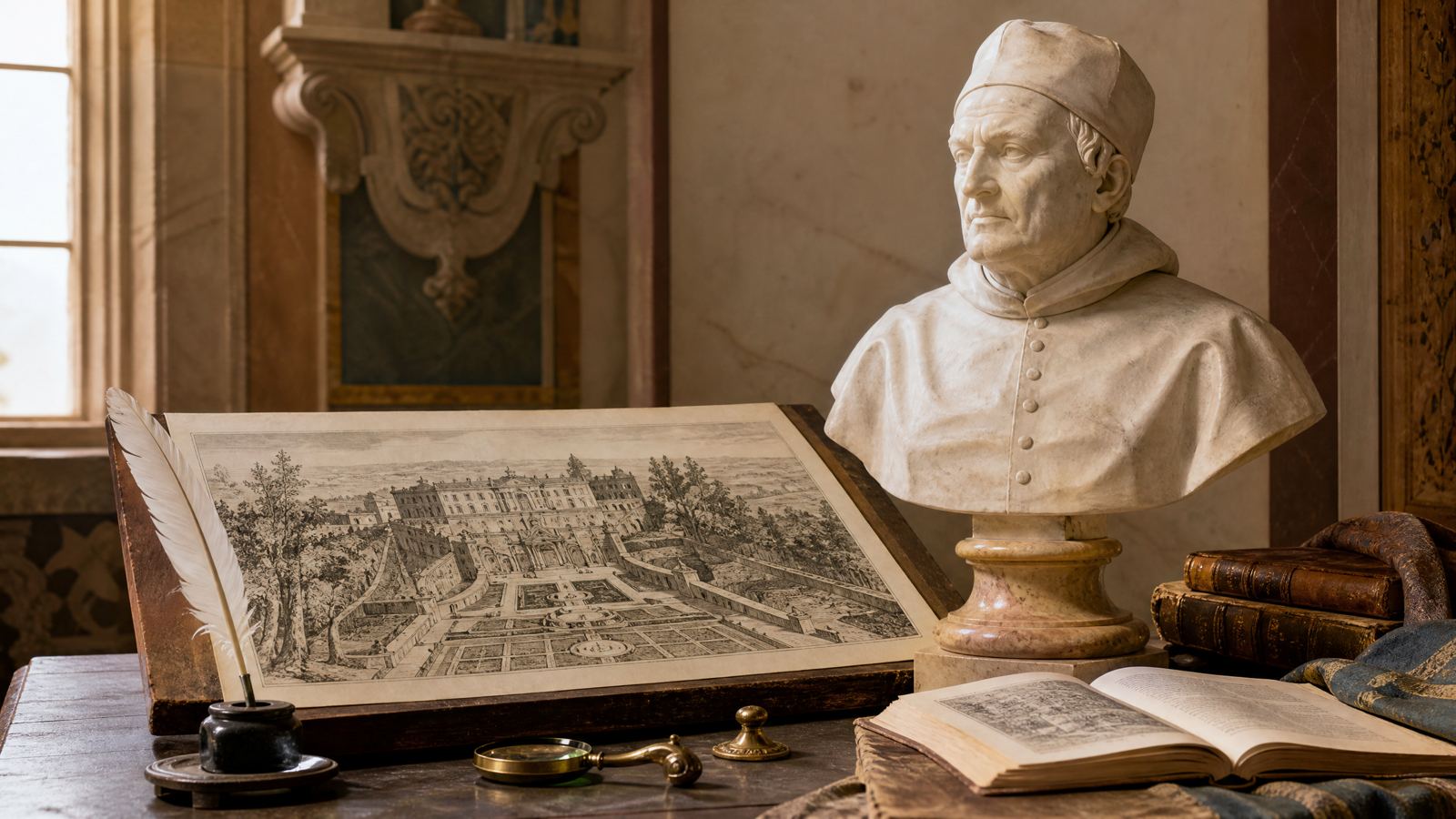
A cardinal's ambition, a river turned into music, and the garden that taught Europe to play with water
Villa d'Este is the masterpiece of the Italian Renaissance garden. Cardinal Ippolito II d'Este wanted a residence in Tivoli to rival the papal court in Rome, and his architect, Pirro Ligorio, gave him one: a palace at the top of a hill and a garden falling down its slope, organised around water.
The fountains still run without pumps. Water from the Aniene river enters at the top of the garden and falls through hundreds of jets, basins, cascades and nymphaea by gravity alone, as it has for more than four centuries.
Ippolito II d'Este is born in Ferrara, son of Duke Alfonso I d'Este and Lucrezia Borgia. He becomes one of the richest and most cultured cardinals of his age.
Disappointed in his hopes of becoming pope, Ippolito is made governor of Tivoli and takes over the old Franciscan convent next to Santa Maria Maggiore as his residence.
Work starts on transforming the convent into a palace and the steep hillside below into a garden, to designs by the architect and antiquarian Pirro Ligorio, with Alberto Galvani as court architect.
The hillside is cut into terraces and a tunnel and aqueduct bring water from the Aniene river, feeding the fountains by gravity alone. Painters including Girolamo Muziano, Livio Agresti and Federico Zuccari decorate the palace.
Ippolito dies with the garden almost complete. His heirs, and later Cardinal Alessandro d'Este, continue the works, adding fountains in the following decades.
New works are carried out in the garden in the 1600s, including changes credited to Gian Lorenzo Bernini, and the villa becomes a model for gardens across Europe.
Under the Habsburgs, who inherited it, the villa is neglected and its antique statues are sold off. Overgrown and half-ruined, it enchants Romantic travellers and painters.
Cardinal Gustav von Hohenlohe takes the villa and restores parts of it. Franz Liszt stays as his guest for long periods and writes 'Les jeux d'eaux à la Villa d'Este'.
After the First World War the villa passes to the Italian state, and restoration begins. In 1944 it is damaged by bombing, and repaired after the war.
UNESCO lists Villa d'Este as a World Heritage Site. Since 2014 it has been run with Hadrian's Villa by the VILLÆ institute of the Italian Ministry of Culture.
Ligorio's garden was meant to be read. Its fountains tell a story about Tivoli, Rome and the cardinal's family, the Este, whose emblem, the eagle, appears all over the garden.
At one end of the Hundred Fountains, the Oval Fountain stands for Tivoli and the mountains, with water pouring over a semicircular cascade you can walk behind. At the other end, the Rometta is a model of ancient Rome. The long terrace of the Hundred Fountains links them, standing for the rivers that carried water from the hills to the city.
Built in a hurry for a papal visit in 1572, it sits on the garden's central axis, with dragons that recall the Este coat of arms and the labours of Hercules, the mythical ancestor the family claimed.
The most famous of all: a water-powered organ that played music using air pushed through pipes by falling water. It amazed visitors in the 16th century, fell silent for centuries and was restored to play again in the 2000s. Today it performs several times a day, starting at 10:30.
Below the organ, the Fountain of Neptune, a 20th-century creation built around older ruins, sends powerful jets into the air above three long fish ponds. Seen from the bottom, it is the garden's great finale.
Ippolito II d'Este, grandson of Pope Alexander VI through his mother Lucrezia Borgia, was a great patron and collector who stood several times as a candidate for pope and never won. Villa d'Este was his compensation.
Pirro Ligorio, painter, architect and antiquarian from Naples, was also excavating Hadrian's Villa at the time. Many ideas, and many statues, passed from the emperor's villa to the cardinal's.
Franz Liszt spent long stays at the villa from the 1860s. His piano piece on its fountains is one of the first works of musical impressionism.
Villa d'Este set the model for the great gardens of the following centuries, from Italy to Versailles. UNESCO calls it one of the most remarkable and comprehensive examples of Renaissance culture at its most refined.
Hadrian's Villa, 5 km away, inspired much of the design and supplied some of its marbles. Most tours combine both. Compare tours →
Open daily from 8:30 (Mondays from 14:00). €15, free for under-18s.